
The good routine isn't the one you never break. It's the one you always return to.
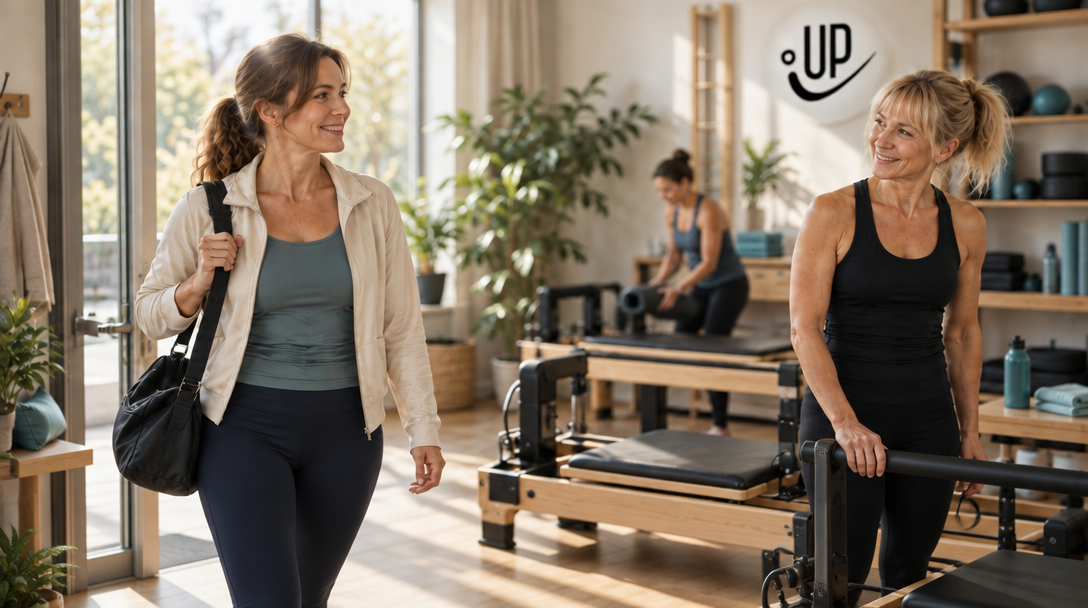
The good routine isn't the one you never break. It's the one you always return to.
We all have an idea of what a "healthy life" looks like.
We wake up early.
Sleep well.
Drink our water.
Eat the perfect breakfast.
Exercise.
Walk.
Stretch.
Don't stress.
Don't eat in the evening what we were sure we didn't want in the afternoon.
And of course, we do all of this consistently.
Week after week.
Month after month.
Year after year.
Then life happens.
And life somehow doesn't read our plans.
All it takes is one busy week
A deadline.
A trip.
A child who needs us.
A few sleepless nights.
An illness.
An unexpected situation.
Or simply a period when too many things happen at once.
And among the first things to disappear is what we do for ourselves.
One workout is missed.
Then another.
The walk is skipped.
We go to bed later.
We don't eat the way we'd like to.
And then suddenly we notice:
"I've completely fallen out of my routine."
And here's where something interesting happens.
Because often the biggest problem isn't the break itself.
But what we think about it afterwards.
"Well, I messed this up too."
Maybe this sounds familiar.
If a week has already been missed, then it doesn't matter anyway.
I'll start again on Monday.
Next month.
When work calms down.
When this period is over.
When I pull myself together again.
And in the meantime, a few days off easily turns into a few weeks.
And a few weeks into a few months.
Not because we're lazy.
But because we gave too much meaning to the fact that the streak was broken.
As if the whole thing only counts if we do it flawlessly.
But I think one of the most important skills for long-term health is not never falling out of rhythm.
But learning to come back.
I don't believe in a perfect routine
At least not one that works unchanged for years or decades.
Because in the meantime, life changes.
Our work changes.
Our family situation changes.
Our energy levels change.
What we have time for changes.
And of course, our bodies change too.
What worked at twenty may not work the same way at forty.
What fit into a calmer period may not fit into a busier one.
But I don't think this means we should give up.
It means we need to build a more flexible system.
One that doesn't collapse just because life gets in the way.
Long-term thinking asks different questions
Not this:
"How many workouts did I miss this week?"
But this:
"Do I move regularly in my life?"
Not this:
"Did I eat perfectly today?"
But:
"Do most of my meals support how I want to feel?"
Not this:
"Do I sleep eight hours every night?"
But:
"Do I generally give my body a chance to recover?"
This is a much less spectacular mindset.
There are no perfect streaks in it.
No one hundred percent.
But it has something I find much more valuable:
sustainability.
Maybe that's why I love watching people who have been moving for years
They're not interesting because they never miss a class.
Quite the opposite.
They have vacations.
Busy weeks.
Illnesses.
Work periods.
Family situations.
Sometimes they disappear for a little while.
Then one day they walk back through the door.
And often I hear:
"Wow, Veronika, I can really feel how much I missed it."
I love this sentence.
Because to me it doesn't mean:
"Something's wrong, I missed it."
But:
"I now know what it feels like when I move."
That's a huge difference.
Maybe one of the most important goals isn't motivation
Motivation is a wonderful thing.
When it's there.
But it's a rather unpredictable companion.
Some mornings we're full of energy.
The next day, every cell of us would rather stay in bed for another half hour.
If we rely only on motivation in the long run, we'll have a hard time.
I much prefer the word connection.
Connection to a form of movement.
To a place.
To a teacher.
To a community.
And ultimately, to ourselves.
When you no longer move because you "have to".
But because you know how you feel afterwards.
You know how much lighter your body is.
You know what it feels like to be able to do something again.
You know how much more energy you have.
And once you've experienced that, you have something to return to.
I think that's why it's so important to love what we do regularly
We don't have to love every minute of it.
Sometimes we don't even feel like doing our favorite form of movement.
I also have days when it's easier to start, and days when it's harder.
But it matters a lot what kind of relationship we have with movement.
If every session is a punishment…
if every workout is about compensating for something…
if we move because we're angry at our body…
then it will be hard to keep coming back to it.
I much prefer this thought:
our body shouldn't be punished for how it looks.
But prepared for what we still want to experience with it.
Because ultimately, it's not about the workout
We talked about this last week too.
I don't want to be strong just to be strong.
But to be free.
I don't want more energy to fit even more tasks into my day.
But so that after the tasks, there's still something left of me for my life.
I don't want to move in ten or twenty years because it looks good in a workout log.
But because I want to go.
Travel.
Do sports.
Walk.
Laugh.
Discover.
Stay curious.
Live.
And from this perspective, the most important question is no longer whether I missed a week.
But whether, in the long run, I find my way back to the life I want.
There's something else I learned from my clients
People are often much stricter with themselves than necessary.
"I didn't do anything for two weeks."
Then we start talking.
And it turns out:
they walked.
Swam.
Hiked.
Spent the whole day sightseeing.
Or simply had a lot going on in their lives.
Sometimes I think we tend to think about movement as if only what is written in the calendar as a "workout" counts.
But the body doesn't care about the category.
It senses whether you're using it.
Whether you're challenging it.
Whether you're moving it.
Whether you're teaching it.
Whether you're resting it.
That's why I love the idea that movement isn't a separate project.
But can be part of our lives.
Of course, sometimes we need to rebuild the habit
And that's work sometimes.
I don't want to create the illusion that it's enough to "listen to ourselves" and everything will fall into place easily.
No.
Sometimes you have to schedule it.
Sometimes you have to start even when staying home would be more comfortable.
Sometimes you need the decision:
"Right now, I'm doing this for myself."
Growth has a price.
Time.
Energy.
Attention.
Consistency.
But I think there's a huge difference between consistency and perfection.
Consistency says:
"This matters to me, so I'll do it again."
Perfection says:
"If I didn't always do it well, I failed."
I believe in the first one.
If you're coming back to something this September…
…don't try to make up for the summer.
You don't have to work out twice as much.
You don't have to punish yourself.
You don't have to prove you're where you were in May.
And you don't have to catch up with anyone.
Start where you are now.
The first time back might be harder.
You might not be able to do as much of something.
You might get tired.
That's completely okay.
Because the goal of the first session isn't to prove:
"I didn't lose anything."
But to reconnect.
With your body.
With movement.
With the routine.
With yourself.
Maybe that's why I don't like the word "restart" so much anymore
Because it suggests that everything that happened before has disappeared.
But it hasn't.
Your body has learned.
You have learned.
You've learned what it feels like to move.
What it feels like to be stronger.
What it feels like to improve at something.
What it feels like to trust a movement again.
And you take this with you.
You may be starting from a slightly different place now.
But not from zero.
That's why this September, I don't want to start a new life
I'd rather continue what I consider important.
Sometimes well.
Sometimes less well.
Sometimes energetically.
Sometimes a little more slowly.
But I always want to find my way back to the things I know make my life better.
To movement.
To learning.
To people.
To curiosity.
To paying attention to myself.
And perhaps for me, this is what a good routine means.
Not a strict system I can never deviate from.
But a path I know so well that I can find my way back even if I stray for a while.
If you take only one thing from this blog…
…let it be this:
What counts is not how many times the streak was broken.
What counts is how many times you chose again what is good for you.
Because one week off doesn't erase what you built over months.
A harder period doesn't make you "lazy".
A summer doesn't reset you.
Life is not a perfectly drawn straight line.
And perhaps our health doesn't have to be one either.
We don't always have to do it perfectly.
Just let there be a few things in life that are good to return to again and again.
I would love movement to be one of them.
Not because we "have to" move.
But because I want my body to help me live a joyful life for as long as possible.
And I wish the same for you.
Don't try to reclaim who you were.
Move forward from who you are now.
– Veronika
Jancsó Veronika
Up Pilates Studio