
Don't build your health from the leftover time
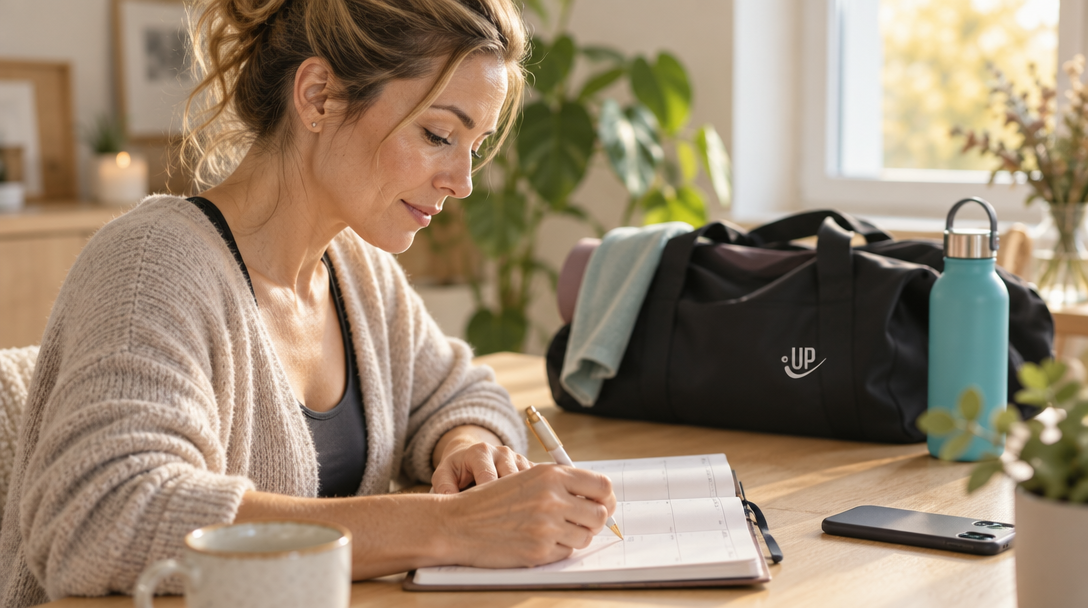
There is a sentence I hear very often.
Sometimes from our guests.
Sometimes from my friends.
And of course sometimes from myself too.
"I simply have no time for myself."
This sentence is usually not spoken as a complaint.
Rather as a fact.
As if we were saying that it's raining, the tram is late, or Tuesday follows Monday.
I have no time for myself.
That's how it is.
Life is like this right now.
There's a lot of work.
I'm needed at home.
There's so much to organize.
Once I'm through this period, things will be different.
Once this project wraps up.
Once the kids are older.
Once this school year is over.
Once there are fewer tasks.
Once everything becomes a bit calmer.
Then the weeks go by.
Sometimes the months too.
And the calmer period somehow never arrives.
Only the names of the tasks change.
H2: A story that could be many of ours
Imagine a woman.
Let's call her Anna for now.
Anna wakes up in the morning already knowing exactly how much has to fit into her day.
Before she's even out of bed, she's organizing in her head.
Who has to leave when?
What's left over from yesterday?
Which message needs a reply?
What's for lunch?
Which meeting does she need to prepare for?
What does she have to pick up on the way home?
And what is the one thing she absolutely must not forget?
Anna would like to move.
Not because a special event is coming up.
Not because someone told her she should lose weight.
She simply feels she needs it.
Her shoulders are tense.
Her back often hurts.
By the afternoon her energy is gone.
She runs out of breath on the stairs sooner than she used to.
And she misses the feeling of feeling strong, light and at home in her own body.
In the morning she still thinks:
"Tonight I'll definitely move a little."
Then the day begins.
An urgent email arrives.
A phone call.
A task that wasn't in the calendar.
Someone asks for help.
A meeting runs long.
On the way home there's one more stop to make.
And at home, everything she left unfinished in the morning is waiting.
At half past eight in the evening, Anna finally sits down.
She would still have twenty minutes to move.
In theory.
But by then it's not really time that's missing.
It's the energy.
The attention.
The ability to make decisions.
She herself.
So she says:
"Tomorrow."
And there's a little disappointment in it.
Maybe a little guilt too.
After all, she did something all day.
There was enough for everyone.
Just not for herself.
H2: Maybe it's not a lack of time
When we say we have no time for ourselves, that is very often a completely real feeling.
I wouldn't like to brush it aside with the nice-sounding phrase that we have time for what we want.
I don't think that's always true.
There are life situations that are genuinely extremely demanding.
A sick family member.
A small child.
Financial hardship.
Too much work.
An unexpected crisis.
A period in which there really is barely any room for movement.
Not every problem can be solved with better time management.
But often the question is not only how much time we have.
It's also who gets that time first.
Urgent tasks are usually loud.
They have a deadline.
Someone is waiting for them.
There are consequences if they don't get done.
Our own health, on the other hand, stays quiet for a long time.
It doesn't send an invitation to our calendar.
It doesn't write a message saying we haven't properly been out in three weeks.
It doesn't stand in our doorway insisting we must deal with it today.
Our body adapts.
For a long time.
It endures that we slept too little again.
That we sat all day.
That we ate in a rush.
That we put off movement to next week again.
It endures.
Except that "it endures" is not the same as "it's well".
H2: The leftover-time problem
Often we try to take care of ourselves by first getting everything else done.
Once I've finished work, I'll move.
Once things are in order, I'll sit down and rest.
Once everyone else is fine, I'll see how I am.
Once I've ticked off every task, I'll deal with what matters to me.
In other words, we regularly give ourselves the leftovers.
The time left at the end of the day.
The attention left after the tasks.
The patience left after caring for others.
The energy left after performing.
The problem is that sometimes nothing is left.
Not because we aren't disciplined enough.
But because a full day doesn't empty itself out just so that we can finally fit into it.
If we always put ourselves at the end of the line, it may well be that our turn never comes.
H2: But isn't it selfish to put myself first?
This question appears in many people.
Especially in those who are used to taking care of others.
The ones you can count on.
The ones who sort it out.
The ones who remember.
The ones who carry the day through even when they've been tired for ages.
For them it may feel strange to say:
"This time is mine now."
As if they were taking something away from someone.
As if the hour spent on themselves meant they were worse parents, partners, colleagues or friends.
Yet making time for yourself doesn't mean others aren't important.
It means that you are important too.
You also belong to the people who need attention.
Rest.
Movement.
Joy.
Care.
Your own needs don't become less real because you're skillful at pushing them into the background.
H2: Your health is not a reward
There is another interesting pattern of ours.
Often we treat our own well-being as if it were a reward.
When I've finished everything, I can rest.
When I've been efficient enough, I can go work out.
When I've performed properly, I can do something that's good for me.
As if we first had to earn our own time.
Yet our health is not a reward for flawless performance.
It's not dessert at the end of the to-do list.
And it's not a luxury reserved for people with calm lives.
Our health is the foundation of being able to be present in everything that matters to us.
Energy isn't only needed to get more tasks done.
Energy is needed for joy too.
So that after work we still feel like talking.
Going for a walk.
Meeting someone.
Playing.
Learning.
Setting off somewhere.
Being curious.
Strength isn't only for carrying more either.
It's also for living more freely.
So we can lift something up.
So we can get up off the floor.
So we can walk through a city.
Do sports.
Travel.
Dance.
And so we can keep using our body, as long as possible, for the life we want.
H2: Your body doesn't build from your plans
On Wednesday I wrote about how our body doesn't know how important our health is to us.
It doesn't see our intentions.
It doesn't hear that from next week we really want to do things differently.
It only registers what we regularly give it.
The load.
The rest.
The movement.
The sleep.
The food.
The attention.
And also what it regularly doesn't get.
That's why long-term health is rarely the result of one big decision.
It's not decided on the first of January.
Not in a thirty-day challenge.
And not in one perfect month.
Much more in those tiny decisions that at first seem insignificant.
Will I go on that walk today?
Will I write the class into my calendar?
Will I cancel on myself again when someone asks me for something?
Will I go to bed a little earlier today?
Will I notice that I'm tired?
Will I ask for help?
Will I keep one hour of the week that nothing else can automatically fill?
These decisions are not spectacular.
But most of our life doesn't happen in spectacular moments either.
It happens on a completely ordinary Tuesday.
H2: You don't have to choose yourself over everyone every day
I think it's important to say this out loud too.
Being important to yourself doesn't mean you always have to come first.
Life isn't that simple.
Sometimes someone else genuinely needs us more.
Sometimes the plan falls apart.
Sometimes we cancel the class because the child is sick.
Sometimes we work longer because something really is urgent.
Sometimes the best decision is to rest instead of moving.
The goal is not to rigidly cling to our calendar under all circumstances.
The goal is for giving ourselves up not to become a constant system.
There's a big difference between adjusting my plan today for something important, and the fact that in reality I never have a place in it.
You don't have to choose yourself over everyone in every moment.
But sometimes you do have to choose yourself.
H2: Start smaller than you'd first like to
When we realize we want to change, it's easy to make too big a plan.
From now on I work out four times a week.
I go to bed on time every evening.
I cook every day.
I walk more.
I use my phone less.
I stretch in the mornings.
The big plan can be inspiring for a few days.
Then a packed day comes, and the whole system falls apart.
I think it's worth starting smaller.
What is the one thing you can truly give a place to next week?
Not in theory.
Not in an ideal life.
In the one you have now.
It can be one Pilates class a week.
Two short walks.
Ten minutes of morning mobilization.
One evening on which you don't take on any more tasks.
Half a day when you're not constantly reachable.
The point is not that it should look big enough from the outside.
The point is that you can keep it up.
A small decision that actually happens can become a habit.
A too-big commitment often becomes yet another piece of evidence that "this just doesn't work for me".
And there's nothing wrong with you.
Maybe you were just trying to follow a system that didn't fit into your real life.
H2: Make the time visible
"Sometime later" rarely arrives.
That's why it can help to give the time you spend on yourself just as concrete a place as any other important meeting.
Which day?
At what time?
For how long?
What could happen that endangers it?
What can you solve in advance?
Who do you need to tell about it?
What do you need to say no to so you can say yes to yourself?
When you sign up for a class, you're not just booking a spot.
In fact, you're reserving a piece of your next week for yourself.
You declare:
in this time, I am important too.
Perhaps that's exactly why a fixed group class or a pre-arranged private session helps so many people.
You don't have to decide again that day whether it fits.
The decision has already been made.
There's a place.
A time.
An instructor.
There are people waiting.
And when the time comes, all you have to do is set off.
That's not always easy either.
But it's often easier than re-negotiating with yourself every tired afternoon whether we're important enough.
H2: What happens if you regularly give yourself time?
A spectacular transformation isn't guaranteed.
Maybe at first you only notice that the day feels better.
Later, that one movement has become steadier.
Your shoulders are less tense.
You get up more easily.
You have more energy left for the evening.
You try new things more bravely.
Or it's simply a good feeling to walk into a place where they know your name and are happy you've arrived.
But something else happens too.
Slowly the message you send yourself changes.
You no longer only say:
"I should work out."
But this:
"I am worth giving time to."
That's a bigger change than it first seems.
Because when you start to consider yourself important, you can move closer to more than just movement.
You can start paying attention differently to your tiredness.
Your boundaries.
Your body's signals.
To what you say yes to.
And to what you should say no to.
H2: You don't have to wait until your body speaks louder
Many of us only start really paying attention to ourselves when something no longer works well.
When it hurts.
When the energy has run out.
When a natural movement has become harder.
When our body no longer signals gently but demands.
Understandable.
It's easier to react to urgent things.
But what would it be like not to wait for this?
Not out of fear.
Not because we dread aging.
But because we'd like to stay on good terms with our body.
We'd like to deal with it not only when it causes a problem.
We'd like to give it time while it's still able, strong, learning and adapting.
Caring for our health is not only repair.
It can also be building.
Preparing.
Connecting.
Preserving what we love in our own lives.
H2: What if you were also on your own list of priorities?
I'm not asking whether from tomorrow you'll always be the first.
Probably not.
And maybe that wouldn't even be the right goal.
I'm only asking:
are you on your own list at all?
Is there time in your week that became yours not because nobody else asked for it?
Is there a decision of yours that is not about a new duty, but about your own well-being?
Is there something you don't only do when you're done with everything else?
If there isn't, don't judge yourself.
Don't immediately build a new, perfect life.
Just look for a little space.
A real one.
One that genuinely fits into your current week.
And when it comes, try not to hand it over at the first request.
It may feel unfamiliar at first.
You may feel guilty.
Part of you may say you could be doing something more useful.
But maybe it's worth reminding yourself:
you are a useful part of the life you keep running.
Not just your work.
Not just your tasks.
Not just what you do for others.
You too.
H2: If you take away just one thing
Don't wait for life to make room for you on its own.
It might not.
Don't wait until every task is done.
There can always be a next one.
Don't wait until you have more energy to start caring for your energy.
And don't wait until your body can only tell you loudly that it needs you.
You don't have to change everything.
You don't have to do it perfectly.
You don't have to choose yourself over everyone else every single time.
But don't always give yourself only from what's left over.
From the leftover time.
The leftover attention.
The leftover patience.
The leftover energy.
Keep something for yourself in advance.
An hour.
An evening.
A walk.
A decision that says:
I am important to myself.
Because your health is not a side project.
Your body is not only there to carry you through your tasks.
This is the body with which you hug the people you love.
With which you set off.
Explore.
Work.
Laugh.
Travel.
Do sports.
Play.
And experience everything that makes all this organizing worthwhile.
Don't let only what you must do remain of it.
Let there be something left for you too.
Don't just endure your life.
Have the energy to be present in it.
And don't try to build your health from the leftover time.
Be important to yourself.
– Veronika
Veronika Jancsó
Up Pilates Studio