
Body awareness vs. performance – a new approach to movement
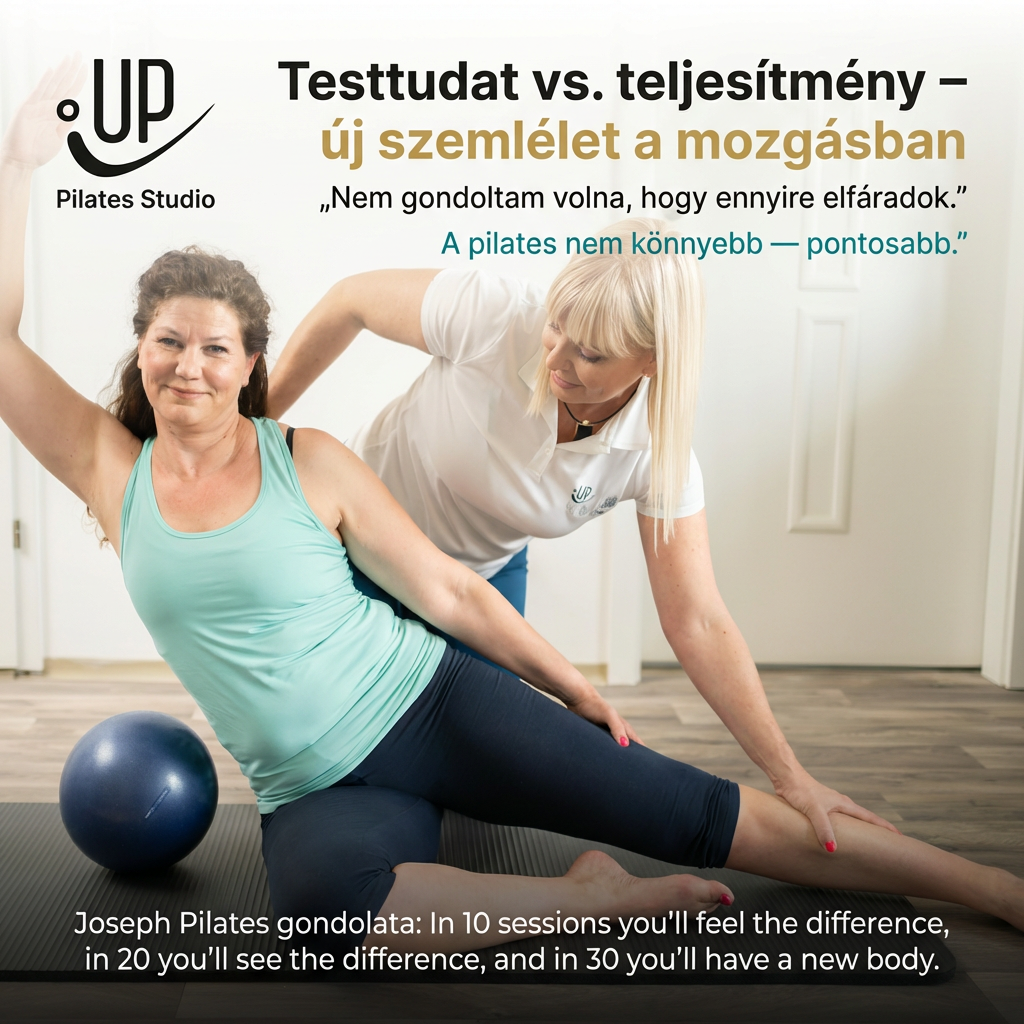
Body awareness vs. performance – a new approach to movement
“I didn’t think I’d get this tired.”
This is one of the most common sentences we hear after a Pilates class.
Not because people underestimate themselves.
But because Pilates often seems quiet from the outside. There’s no loud music, no rushing, no “ten more reps!”. Just concentration, control, breathing — and meanwhile, the muscles are working very seriously.
A story familiar to many
Nóra attended intense workouts for years. She loved the feeling of being completely out of breath, of “feeling that she had worked out.” When she first came to a Pilates class, she said with a smile:
“This will be a rest day.”
After the first 15 minutes, she already felt that something entirely different was happening. Not the usual muscles got tired first, but her body started working deeper, more stably. At the end of the class, she lay quietly on the mat, then sat up and simply said:
“This was harder than I thought. It just doesn’t look like it from the outside.”
Pilates is not easier — it’s more precise
The difference is not in the lack of intensity, but in quality.
Pilates:
- activates deep stabilizing muscles
- requires continuous muscle control
- works strength, balance, and coordination simultaneously
- and doesn’t allow us to “get away with” movements by momentum
One of Joseph Pilates’ most famous thoughts summarizes this perfectly:
“In 10 sessions you’ll feel the difference, in 20 you’ll see the difference, and in 30 you’ll have a new body.”
(After 10 sessions you’ll feel the difference, after 20 you’ll see it, after 30 you’ll have a new body.)
This sentence doesn’t promise quick results, but consistent, real progress — the kind of strengthening that is not only visible but also felt in function.
Pushing boundaries – differently
In Pilates, we develop, strengthen, and push our boundaries in the same way — but not through brute force, but through control. Muscles not only become stronger, but they start working together more intelligently, and the body doesn’t fall apart under load, but becomes more stable.
This is where body awareness and performance meet.
There’s no need to choose between the two — in well-structured movement, both are present simultaneously.
A new question after your workout
At the end of your next workout, don’t just ask:
“Am I tired?”
But also this:
“Does my body work better now than an hour ago?”
If the answer is yes, you’re on the right track.
✨ Pilates is not an easy workout.
But it teaches you how to be simultaneously strong, aware, and resilient in the long term — and that’s the kind of strength that truly matters.