
The effect of Pilates on mental health
Pilates has been used since the 1920s, primarily due to its effects on the body. However, more and more research supports the idea that the benefits of Pilates extend beyond a flexible, strong, and slender body.
Pilates also has a positive effect on mental health – let's see how!
The connection between breathing and mindfulness.
Breathing can be encountered in many places – including yoga, the Alexander Technique, and meditation – because breathing is one of the strongest tools for calming down. This is why it is an essential part of Pilates, and Pilates himself attached great importance to breathing. Each exercise uses a specific breathing pattern, which, when followed, supplies oxygen to the muscles and "washes out" unnecessary substances from the bloodstream. All of this contributes to the effectiveness of the exercise and the results.
However, breathing has more benefits than just this. While we concentrate on breathing correctly, we won't be dwelling on having a test tomorrow or forgetting to buy milk again. We exclude all thoughts, focusing only on breathing, and feeling our muscles working.
This leads us to the next point, which is none other than…
Helps with stress management and relaxation.
Pilates is an excellent stress and tension reliever. To quote Elizabeth Scott, a wellness coach: "Exercise reduces stress hormones like cortisol and increases endorphins, which act as the body's happiness hormones, significantly boosting our mood." This is true for all forms of exercise. However, Pilates has another very important quality, which is the focus mentioned earlier. If we don't think about what makes us tense, then the tension also disappears. In addition, many people experience that when the full concentration ceases after a workout, stress-inducing thoughts become much clearer and more transparent.
Pilates improves memory and trains the brain.
When we do something continuously, after a while we completely switch off and go into automatic mode. Business people realized this many decades ago, which is why they try to make work tasks as dynamic as possible. If we perform the same few movements for days, weeks, or even years, we dull our brains, not to mention significantly increasing the risk of workplace accidents.
The same applies to exercising. If we run on the treadmill every single day, after the first few times we will step onto the machine like a robot, while our brain will be somewhere else entirely. It's better not to think about what nasty injuries we could sustain if our foot accidentally slips off the belt because we're not paying attention.
This risk does not exist with Pilates, as every exercise presents a new challenge, not only for our body but also for our brain.
We can also approach this fact from a more scientific perspective. Exercise pumps blood to the brain, allowing us to think more clearly. The hippocampus, responsible for storing memories, will grow, thus improving our memory. In addition, exercise can preserve the connections between the brain's nerve cells. All of this results in a healthy, resilient brain.
Finally, Pilates is an excellent method for overcoming depression.
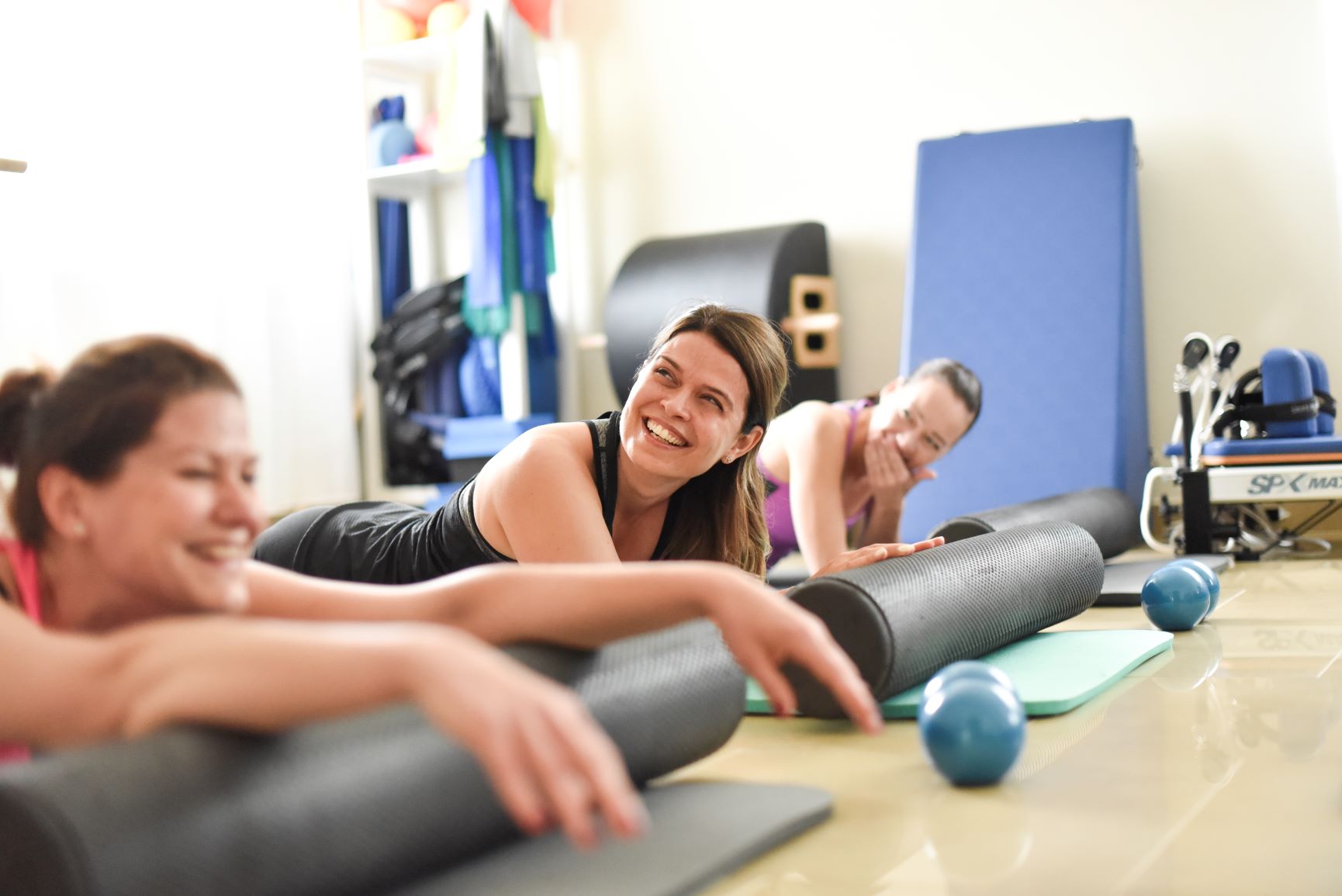
Basically, all forms of movement help us in the fight against depression and other mental illnesses due to their aforementioned physiological effects. However, Pilates offers the opportunity to socialize through courses. If we are struggling with depression, even enrolling in a course often seems like a big challenge, but it is absolutely worth it! A few times a week, we get out of the house, exercise a little, distract ourselves from negative thoughts, release stress, and most importantly, we take care of ourselves!