
Stress in the body: how Pilates relieves chronic tension?
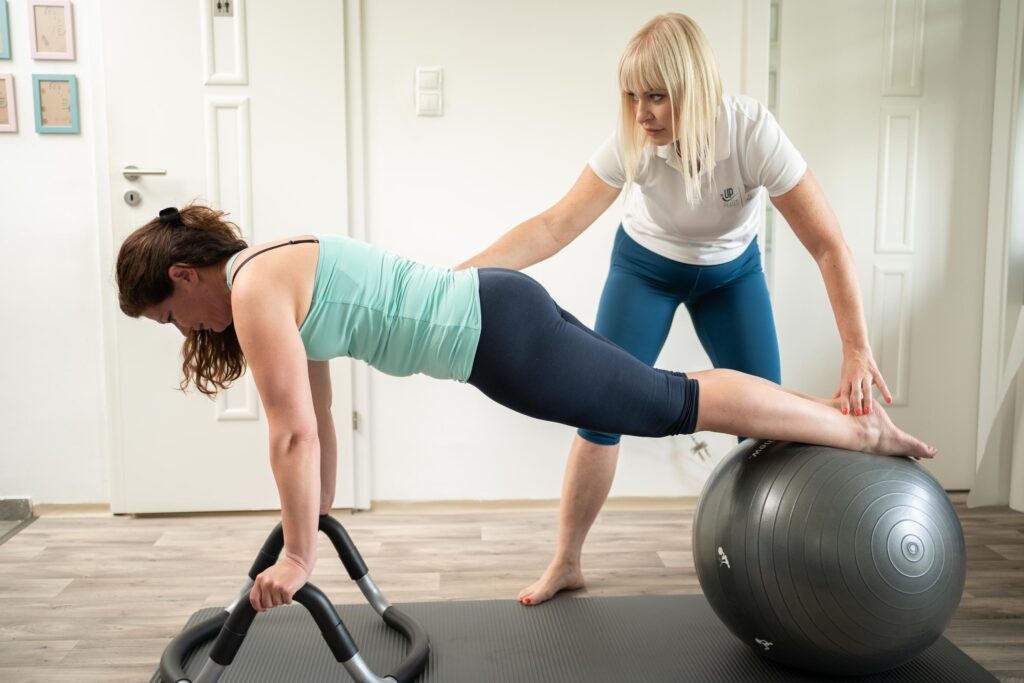
There's a point at the end of the day when you finally sit down and feel it: your shoulders are tense, your neck is stiff, your lower back aches.
Nothing "spectacular" happened – yet your body is tired.
This is the physical imprint of stress.
Most of us think of stress as a mental state, but for the body, stress is a physical reaction: muscles tense up, breathing becomes shallow, and the nervous system remains in a state of readiness. If this persists, chronic muscle tension develops, often manifesting as neck, shoulder, back, or lower back pain.
The good news: the body can learn to relax just as it learns to tense up.
How is stress stored in the body?
In stressful situations, the body automatically switches into "defense mode":
- muscle tone increases
- shoulders slump forward
- breathing becomes faster and shallower
- superficial muscles take over the work instead of deep stabilizing muscles
If this state repeats day after day, the muscles get used to the tension, and after a while, they don't fully relax even at rest. This causes the feeling of waking up stiff in the morning, even if we haven't done intense physical work.
Why is Pilates effective against stress?
The uniqueness of Pilates is that it not only strengthens but also re-regulates the nerve-muscle connection and breathing. This helps release chronic tension on multiple levels.
1. Conscious breathing
In Pilates, breathing is not a secondary element but an integral part of movement. Deeper, rhythmic breathing activates the parasympathetic nervous system, which is responsible for the body's "rest" state. This alone reduces the physiological effects of stress.
2. Activation of deep stabilizing muscles
When the deep core muscles re-engage, superficial muscles – such as those around the shoulders and neck – are freed from overload. For many, this brings a noticeable sense of lightness after just a few sessions.
3. Slower, controlled movement
Pilates exercises are not rushed but precise and conscious. This helps the nervous system exit its constant state of readiness, and the body gradually learns: it doesn't have to be constantly on guard.
4. Developing body awareness
When you start to notice where you hold tension in your body, you also gain the opportunity to consciously release it. This is one of the most important steps in releasing chronic stress.
What changes can you experience?
As a result of regular Pilates practice, many clients report that:
- neck and shoulder tension decreases
- posture improves
- breathing becomes deeper and calmer
- it's easier to "switch off" after a stressful day
- recurrent back pain decreases
The change is often not dramatic overnight, but a gradual, stable improvement that makes a long-term difference in everyday life.
Tension is not an enemy – it's a signal
The body doesn't tense up by chance. It signals: too much burden, too little rest, lack of conscious movement.
Pilates doesn't "suppress" this signal but helps restore balance: it gives strength while also allowing space for relaxation.
Concluding thought
A stress-free life is not a realistic goal – but a body living in tension is not a necessary state. With proper movement, breathing, and attention, the body can learn to relax again.
✨ If you often feel persistent tension in your shoulders, neck, or back, it's worth choosing a form of movement that not only strengthens but also releases.
Pilates helps exactly with this: bringing lightness back into movement – and into everyday life.